An asset library has an unusual shape as data. It is large, often hundreds of gigabytes. It barely changes, because a pack you downloaded two years ago is byte for byte what it was. And it is genuinely irreplaceable, not because the files are rare, but because the work of finding them, choosing them and recording what each one permits is not something you would do twice.
Most backup advice is written for documents, which are small and change constantly. Asset libraries want different treatment.
#Why the obvious options disappoint
Copying the folder to another drive is the thing everybody does, and it is better than nothing. The problem is that it is manual, so it happens when you remember, which is after the interesting week rather than during it. And a copy is not a history: if a folder got mangled and you copied afterwards, you have faithfully preserved the mangling.
Consumer cloud sync struggles at this size and shape. Hundreds of thousands of small files is the worst case for most sync clients, the free tiers do not reach the sizes involved, and you are paying monthly to store a copy of files that are, in most cases, still available for free from the sites you got them from. The part worth protecting is not the bytes, it is the record attached to them.
Version control is the wrong tool and everybody knows it, but it is worth saying why: git stores every version of every binary forever, so a repository of 3D models grows without bound and never shrinks.
#What the shape actually wants
Three properties, and they follow directly from large, unchanging and irreplaceable:
- Deduplicating and incremental. The second backup of a 300 GB library should take minutes and almost no new space, because almost nothing changed.
- Snapshots, not a mirror. You want yesterday as well as today, so a mistake is recoverable rather than faithfully copied.
- Encrypted before it leaves. If it is going anywhere you do not physically control, it should be unreadable there.
#What Tessera does about it
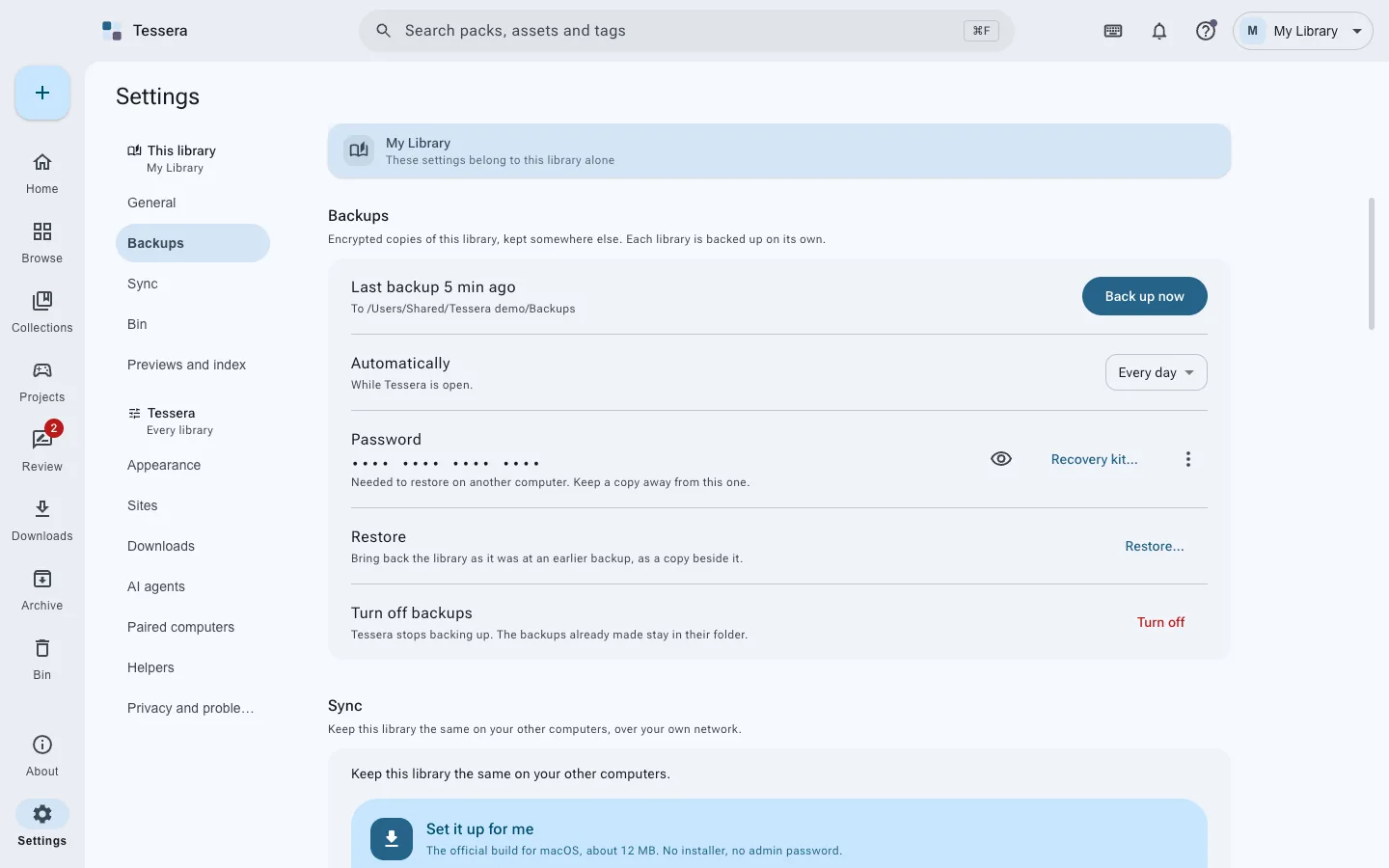
Backups run through Kopia, which is free, open source, and does all three of the above. Tessera drives it rather than reimplementing it, which means your backups are in a documented open format that a tool other than Tessera can read. That matters more than it sounds: a backup you can only restore with the program that made it is a hostage, not a backup.
It can go to a folder, an external drive, or any cloud storage you already have an account with. There is no Tessera server, no account, and no middle. The destination is yours, the encryption key is yours, and nothing is readable at the far end without it.
#Sync is a different job
People ask for backup when they mean sync, and the reverse, so it is worth separating them.
Backup answers: the drive died, or I ruined something last Tuesday. It needs history.
Sync answers: I want the same library on my desktop and my laptop. It needs no history at all, and a mistake propagates instantly, which is exactly why it is not a backup.
Tessera does sync through Syncthing, directly between your own machines, with nothing in the middle and no account. Useful, and not a substitute for the other thing. If you do both, the backup is what saves you, and the sync is what saves you time.
#The one thing to know about reading in place
If you use indexing in place to keep a large drive where it is, those files are not inside your library, and so they are not in your backups either. Tessera backs up the library, and it cannot back up a drive it was merely told to read.
That is the trade for not copying 300 GB, and it is a fine trade as long as you know you made it. Either back that drive up by some other means, or take the packs that genuinely matter into the library properly, which you can do at any time.
#The boring advice
Keep one copy on a drive in the building and one somewhere else, snapshot rather than mirror, and test a restore once so you find out now rather than later that you never actually configured the thing.
None of this is specific to game assets. What is specific is the thing worth protecting. If the drive died tomorrow, the models are mostly redownloadable. The record of what every one of them is licensed under, and where it came from, is not.
Install Tessera, or read backups and sync.