Open any asset drive that has been in use for more than two years and you will find the same model three or four times, in slightly different folders, at slightly different sizes, and you will not be able to say which one is the original.
This is not a discipline problem. It is structural, and it is worth understanding before trying to fix it.
#How it happens
A folder can express one classification. Every time you need a different one, the only mechanism available is a copy.
- You file by pack, then need everything for one project, so you copy into the project folder.
- You copy assets into an engine project, because they have to be there to be used.
- You download a bundle that includes a pack you already own from a different sale.
- You export a converted version, because the engine wanted FBX and the pack had glTF.
- You keep the 4K and the 1K because you have not decided yet.
Every one of those is a reasonable decision made for a good reason. Together they produce a drive where nothing has a single home.
#What it actually costs
Disk is the least of it, and the reason people underrate the problem.
You cannot tell which one to edit. Fix the tree, and three copies still have the bug. This is the expensive one, and it shows up as a bug that comes back.
The license record fragments. The copy in your project folder has no readme next to it. Whether that tree needs crediting is now only answerable by recognizing it by eye.
Backups multiply it. Four copies is four times the transfer, forever.
You buy things twice. Common with bundles, and genuinely annoying.
#What does not fix it
Deduplication tools by file name find almost nothing, because the copies have been renamed. Deduplication by content finds the exact copies and misses the converted and resized ones, which are the ones causing the bugs.
Deleting aggressively is the worst option, because the copy in your engine project is the one things reference.
#What does
Keep one library where the pack is the unit, whole, as its author assembled it, with its license attached. Then stop copying out of it for organizational reasons:
- To group things, use a collection that points at files instead of copying them. A file in six collections is one file on disk.
- To use things, copy into the game, and record that you did, so the copy in the project is known to be a copy of something rather than an orphan.
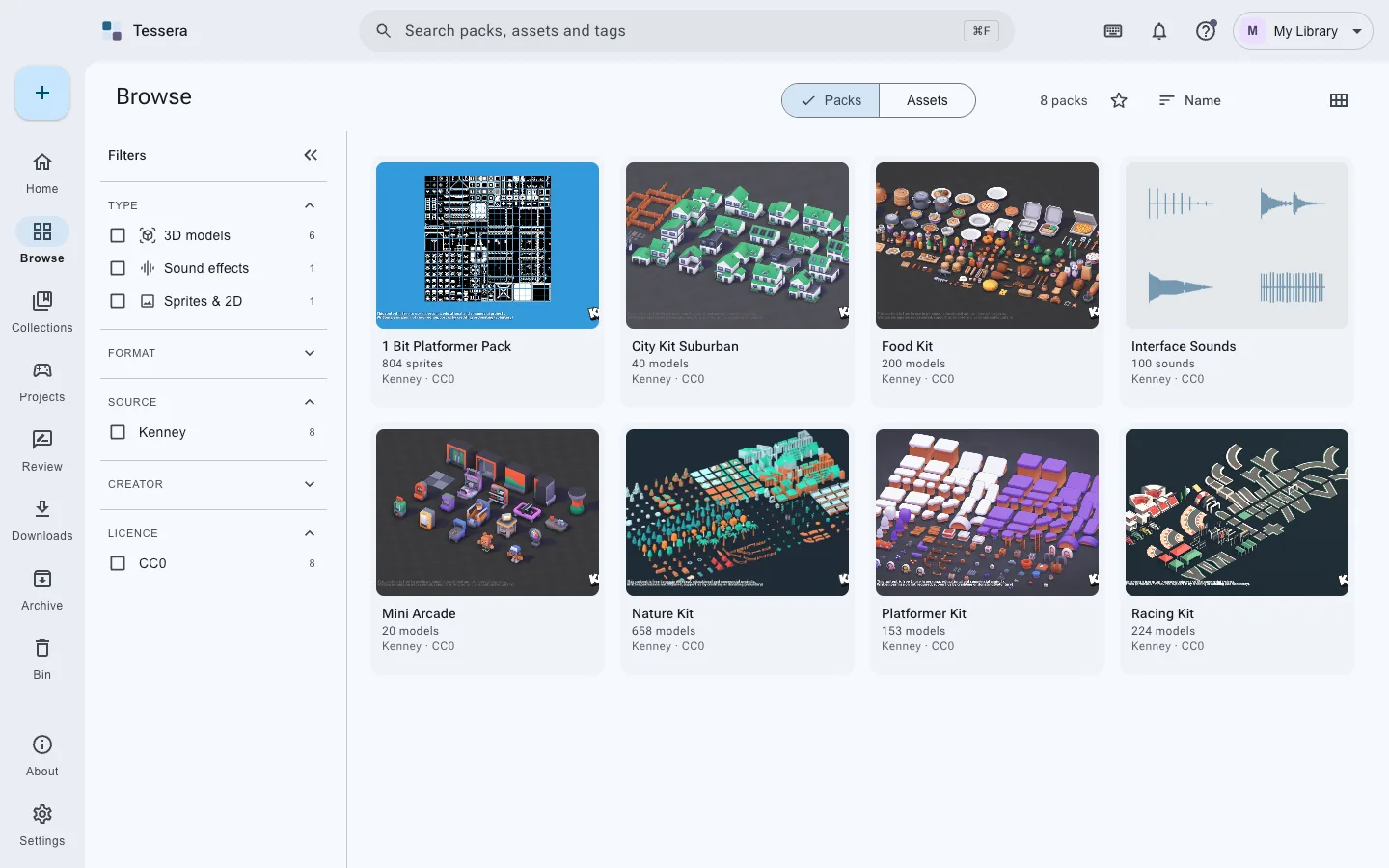
Tessera's project manifest is exactly that record: for every asset in a game, which pack it came from, its license and when it arrived. The copy still exists, because the engine needs it, but it is no longer an orphan, and the original is still the single place to make a change.
Install Tessera, or read collections and games and projects.