Every asset library has some of these. A folder with no readme. A model somebody sent you in a chat four years ago. A texture from a site that has since gone offline.
They are not all the same problem, and treating them as one is why they sit in a project for years as a quiet liability.
#First, look properly
A surprising number of "unlicensed" assets are nothing of the sort. Before concluding anything, check:
- Inside the archive. License files are routinely deleted during unzipping as clutter. If you still have the original zip, the answer may be in it.
- Filenames and metadata. Models and images often carry the author in their embedded metadata.
- The download folder's neighbors. The readme is frequently one level up from where you looked.
- The site, through the Internet Archive. A dead site's terms page is often still readable, and a dated snapshot is real evidence of what was offered at the time.
This finds the answer more often than you would expect.
#Then, sort what is left into three piles
Traceable to a person. You know who made it and can ask. Ask. Creators respond, and a short message saying "may I use this in a commercial game, and how would you like to be credited" resolves it permanently. Save the reply.
Traceable to a site with terms, but not to a file. You know it came from a particular library whose whole catalog is under one license. That is reasonable grounds, and you should write down your reasoning rather than the conclusion alone, so a future you can re-evaluate it.
Untraceable. You genuinely do not know where it came from.
#The honest answer for the third pile
An asset you cannot license is an asset you should not ship.
That is unwelcome, especially when the file is good and has been in the project for two years. But the risk is asymmetric: the cost of replacing it is a few hours, and the cost of being wrong is a takedown after launch, or worse if the work turns out to be someone's commercial product that was reuploaded somewhere.
Nothing stops you keeping it for prototyping. Mark it, keep it out of builds, and replace it before release.
#Making the pile stop growing
The pile exists because there is no moment in a normal workflow where the question gets asked while the answer is still available.
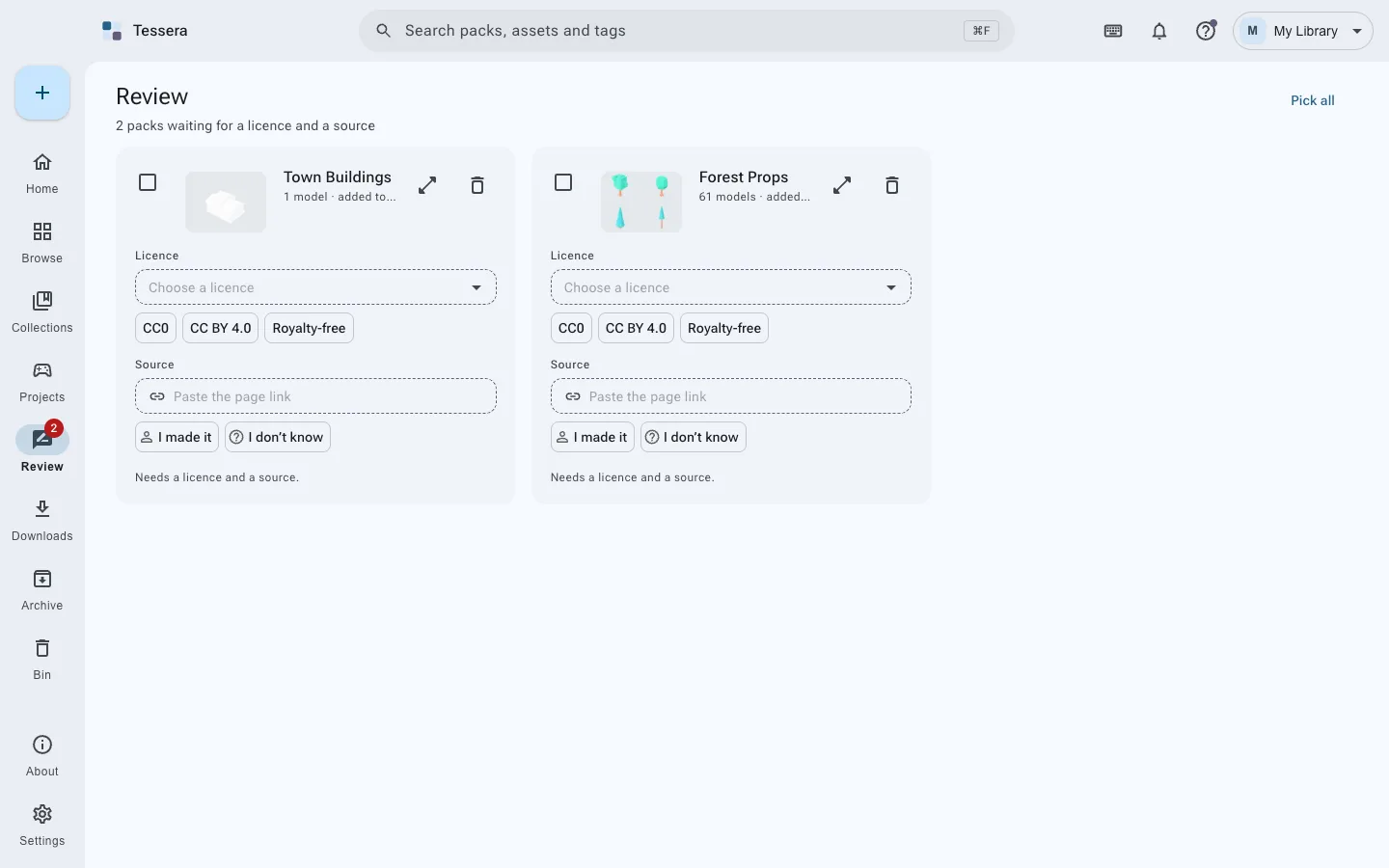
Tessera makes that moment explicit. A pack whose license cannot be established does not silently join the library. It waits in Review and asks, once, at the point when you still know, and one answer settles it for every file inside. What you have already lost is lost, but nothing new joins the pile.
Install Tessera, or read review.