Every game that ships with somebody else's art has the same moment in it. The build is done, the store page is written, and somebody opens a text file called credits and tries to remember where four hundred files came from.
It is a strange moment, because nothing about it is hard. The licenses were all readable when the
files were downloaded. Most of them asked for one line of text. The trouble is that the download
happened eleven months ago, in a folder called assets_new_2, next to assets_new_final, and the
license file that came with it was either deleted as clutter or is still sitting there, unread,
called LICENSE.txt, identical in name to nine other files that say completely different things.
#The licenses are not the difficult part
There is a small number of licenses that game assets actually arrive under, and they ask for very little.
CC0 asks for nothing. You can use the work, change it, sell the result, and never mention anyone. A great deal of what is freely available for games is CC0, and for those files the credits file is a courtesy rather than a condition.
CC-BY asks for one thing: say who made it. The wording varies, the spirit does not. Name the creator, and where it is practical, link to the original and say what you changed.
CC-BY-SA asks for that, and adds that anything you make from the work carries the same license onward. For a texture painted onto a model in a closed-source game, that is a condition worth reading carefully rather than assuming.
Then there are the store licenses, which are not Creative Commons at all. These are usually per-seat, usually forbid redistributing the asset in a form another developer could extract and reuse, and usually permit exactly what you want to do, which is ship it inside a game. They are also the ones most likely to differ from each other, which is why the actual document matters more than the general idea of it.
None of this is complicated. What is complicated is answering, for one file out of four hundred, which of those five paragraphs applies to it.
#So it is a filing problem
The information you need at the end is the information you had at the beginning. You had it at the moment of download, when the page was still open in front of you, when you knew the creator's name because you had just read it, and when the license was one click away.
Ten seconds of typing then saves an afternoon later. Almost nobody does it, and the reason is not laziness. It is that there is nowhere obvious to put it. A folder does not have a field for "creator." A zip file does not have a field for "the license this was offered under." So the knowledge goes into the only place available, which is your memory, and memory is exactly the wrong place, because the whole point of an asset library is that you will come back to it in a year.
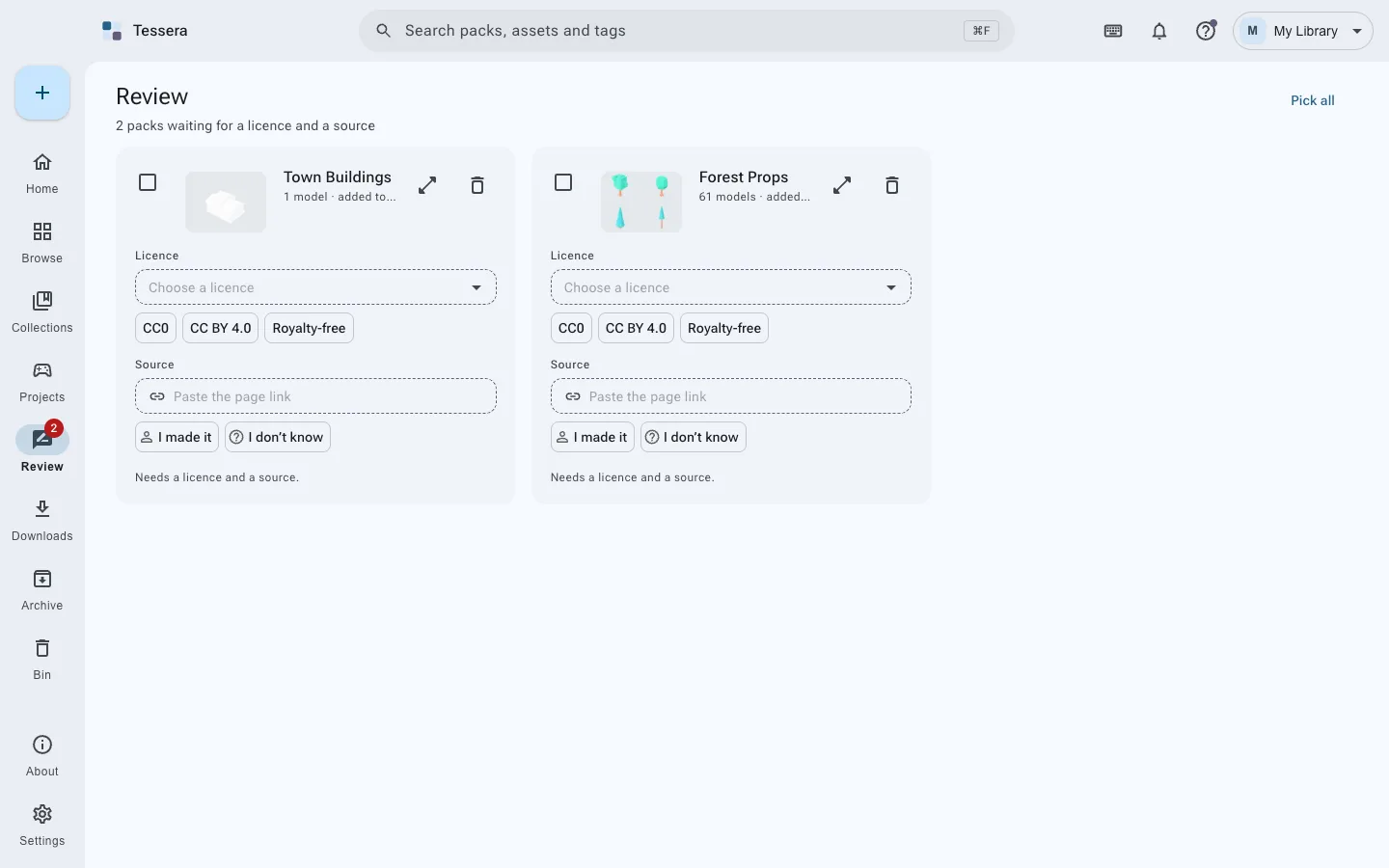
This is what Tessera is built around. A pack comes in, and before it is part of your library it sits in Review and asks two questions: what license is this under, and where did it come from. Often it can answer both itself, because the license file was in the zip, or the folder came from a site whose terms it knows. When it cannot, it asks, once, at the only moment when you actually know the answer.
After that the questions are settled forever, for every file in that pack, and they travel with the files rather than living beside them.
#What that buys you at the end
The reason to record it is not tidiness. It is that a recorded license can do work for you.
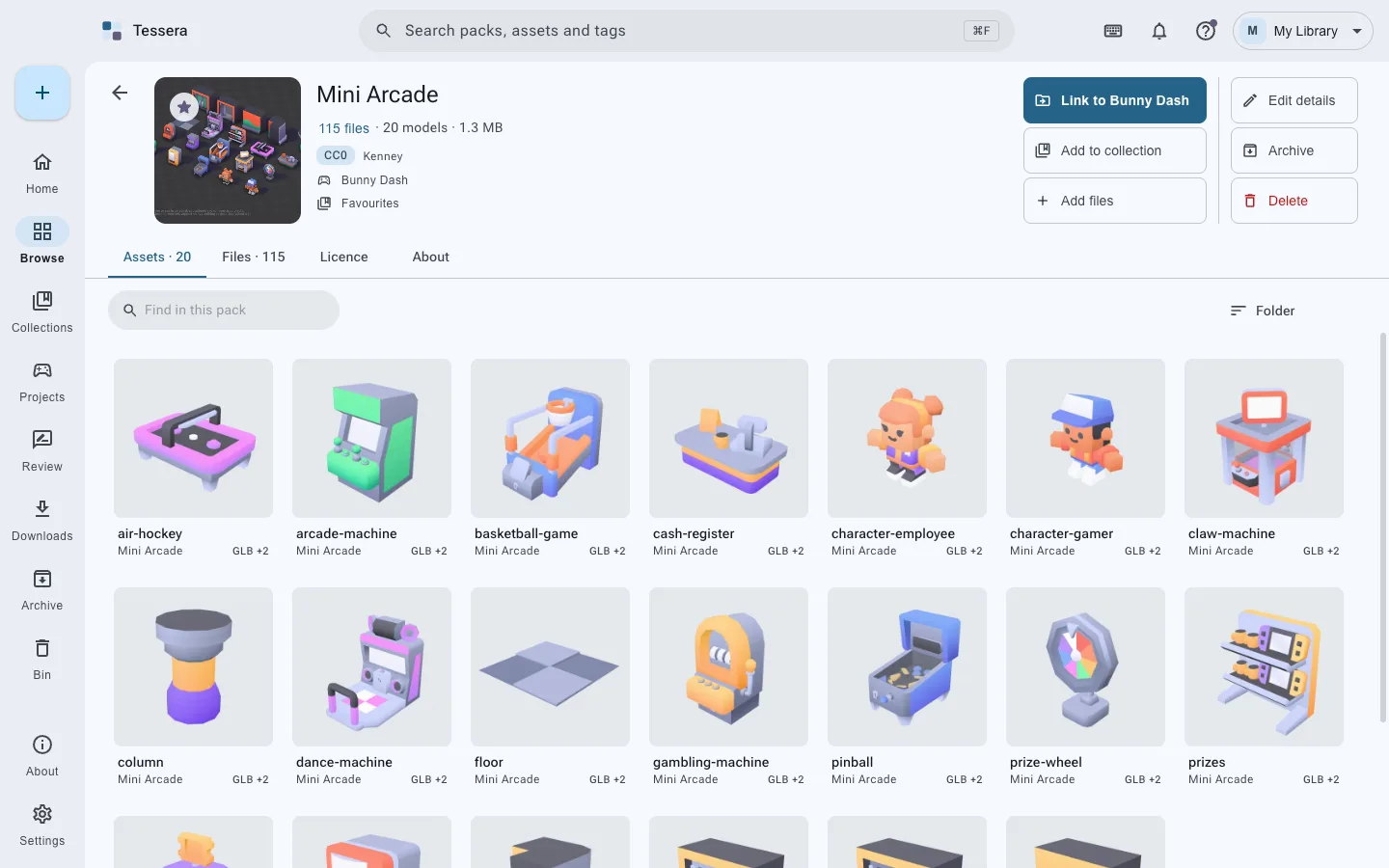
When you copy a pack into a game, Tessera writes a CREDITS.md next to it, listing every pack in
that project, who made it, what it was licensed under, and where it came from. The credits file
is not something you write at the end. It is something that already exists, and has existed since
the first asset went in, and has been correct the entire time.
You can also ask the library the question in the other direction. Show me everything in this game that needs attributing. Show me everything under a share-alike license, because I need to think about that one properly. Show me everything whose license I never actually confirmed, which is the most useful question of all, because that list is the risk, and it is normally invisible.
None of this requires you to become careful. It requires the careful moment to happen once, at the door, instead of four hundred times at the end.
#The part nobody tells you
Recording a license does not make you compliant. It makes you informed, which is a different and much more achievable thing. Tessera records what a pack says about itself and what you told it. It does not give legal advice, it cannot read an unusual store agreement for you, and a file whose license simply cannot be established should be treated as what it is, which is a file you should not ship.
But the honest version of asset licensing was never "read every EULA." It was always "know what you have." That part is a filing problem, and filing problems have solutions.
Tessera is free and open source, and runs on macOS, Windows and Linux. Install it, or read how licenses are recorded.