There is no shortage of free game assets. There is a shortage of knowing, a year later, which of them you are allowed to ship and which one needs a line in your credits.
So this is a list of the places worth knowing, sorted by the only thing that matters when you come back to the file much later: whether the site has one license for everything, or a different one for every download.
#The easy ones: everything is CC0
These sites publish under CC0, which means you can use it, change it, sell the result, and never mention anyone. You should still record where it came from, because in a folder a year from now a CC0 file and a CC BY file look exactly the same.
| Site | What is there |
|---|---|
| Kenney | Thousands of 2D sprites, low-poly 3D kits, UI packs and sound effects, all in one house style |
| Poly Haven | HDRIs, PBR textures and scanned models, at high resolution |
| ambientCG | PBR materials, a great many of them, in every map you need |
| Quaternius | Low-poly model packs by theme: nature, dungeon, vehicles, characters |
If you are starting out and want to stop thinking about licensing entirely, build from these four and you can. That is a real strategy, not a compromise.
#The mixed ones: check every single file
These are the valuable ones, and the dangerous ones. Every submission carries its own license, chosen by whoever uploaded it, and they range from CC0 to share-alike to non-commercial.
OpenGameArt has an enormous amount of good work under everything from CC0 to CC BY-SA to GPL, plus its own OGA-BY license. The license is on the submission page, not in the download, which is exactly how the knowledge gets lost.
Freesound is the same story for audio. A lot of CC0, a lot of CC BY, and a meaningful amount of CC BY-NC, which you cannot use in a game you sell. The license is per sound, and packs by one author are not necessarily all under the same one.
itch.io asset packs are per author. Some state their terms clearly on the page, some put them in a readme inside the zip, and some say something vague like "free to use in your games" which is a permission but not a license. When it is vague, ask.
Sketchfab has downloadable models under Creative Commons licenses alongside a paid store. The license is shown on the model page, and CC BY is common, so plan on crediting.
#Fonts have their own rules
Google Fonts is almost entirely under the SIL Open Font License, with a few under Apache 2.0. For a game this is essentially always fine: you may embed the font, and you may modify it, as long as you do not sell the font by itself and you rename it if you change it and the license reserves the name.
The catch people meet is not legal, it is practical: a font file in a repository with no note of where it came from is impossible to license-check later, and fonts are the assets most likely to arrive by being dragged out of a design tool.
#What you buy is not Creative Commons
Assets from the Unity Asset Store, Fab, or a creator's own shop come under that store's terms, not a public license. The shape is usually: one seat per developer, ship it inside a compiled game freely, do not redistribute it in a form another developer could pull out and reuse.
That last clause is the one that catches people, and not where they expect. Shipping the game is
fine. Putting the whole project including the source .fbx in a public repository as a portfolio
piece usually is not.
#The thing that actually goes wrong
Notice what every warning above has in common. The license is never hard to find at the moment of download. It is on the page you are already looking at, or in the zip you just opened.
It becomes impossible to find eleven months later, when the file is one of four hundred in a folder, the page is long closed, and you genuinely cannot remember whether this particular tree came from Quaternius or from a bundle you grabbed at three in the morning.
That is the whole problem, and it is a filing problem rather than a legal one. The fix is to record the license and the source at the moment you download, when it costs ten seconds, instead of at the end of the project, when it costs an afternoon and some of it is simply unrecoverable.
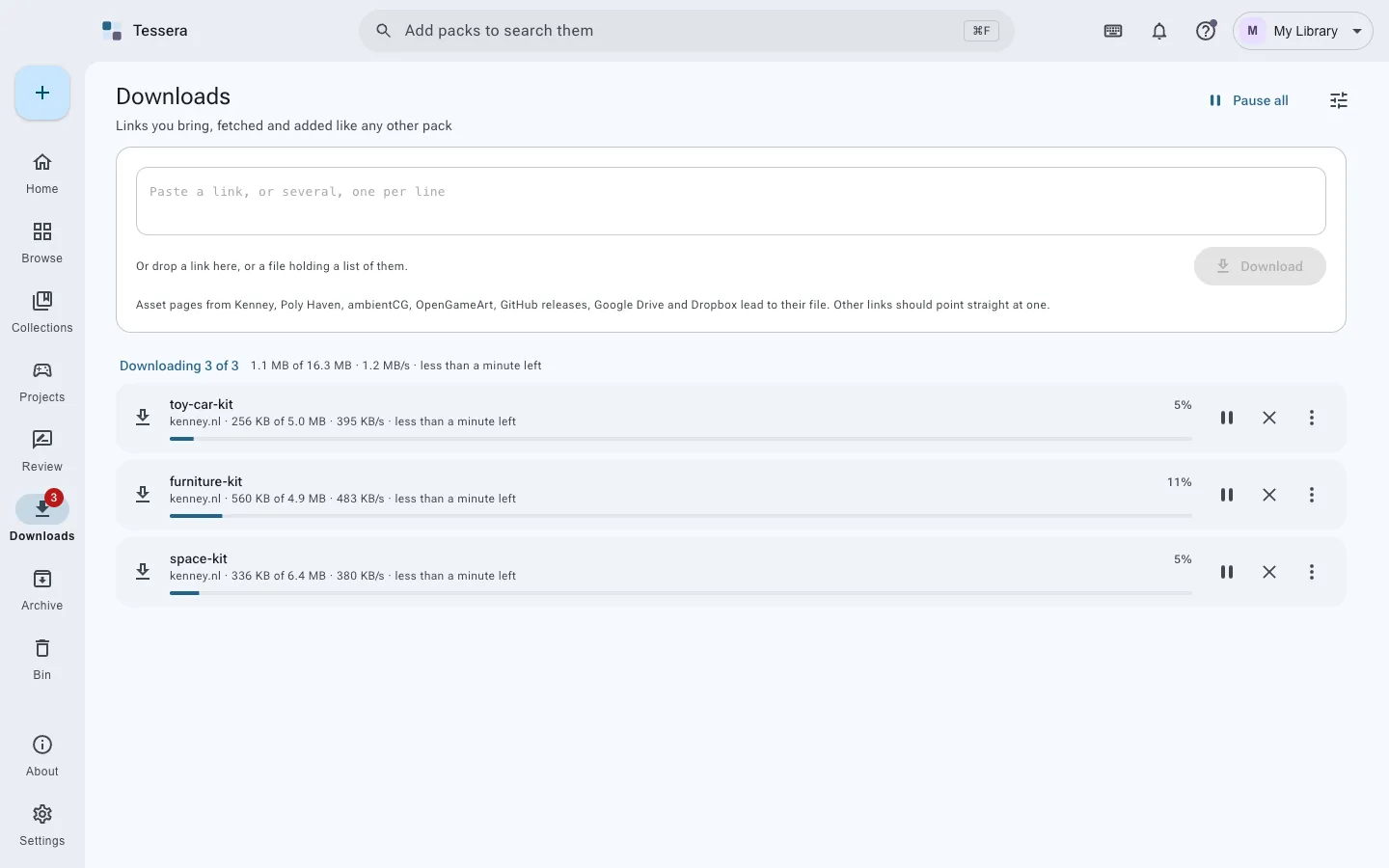
Tessera does that part for you. Paste a link and it recognizes a good number of these sites and fills in the license and the source itself. When it cannot, the pack waits in Review and asks, once, rather than joining the library on a guess. And when you copy assets into a game, the credits file is written from what was recorded, so the acknowledgements are correct because they were never written by hand.
Install Tessera, or read downloads and licenses.