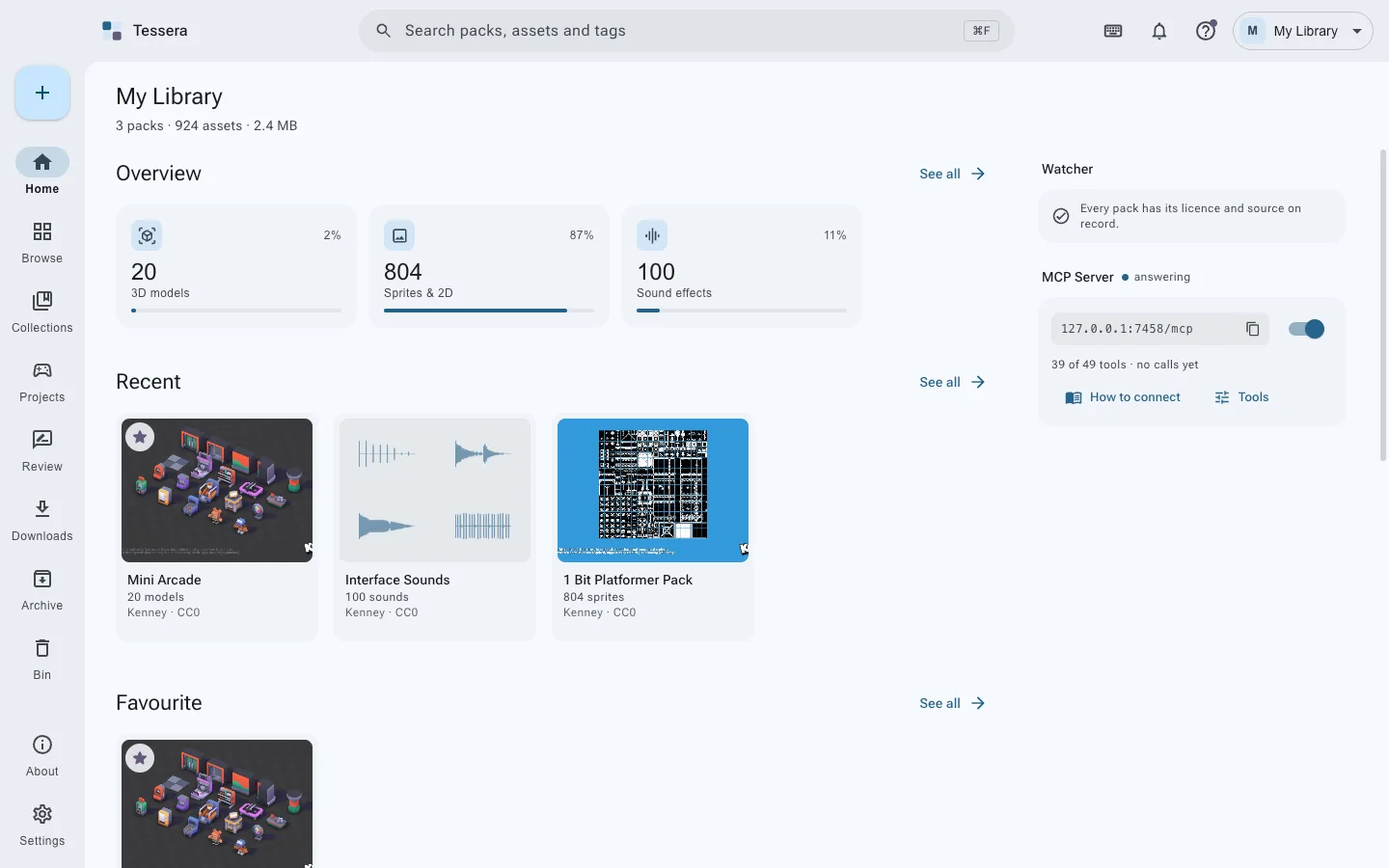
Tessera 1.0.0 is out. It is free, open source under GPL-3.0-or-later, and it runs on macOS, Windows and Linux. There is no account to make, because there is nothing to sign in to.
It is a library for the assets you already own. Not a store, not a marketplace, not a service. Everything lives in a folder you chose, on your own disk, in a layout you can read without Tessera installed.
#Why it exists
Every game that ships somebody else's art has the same moment in it: the build is done, and somebody opens a text file called credits and tries to remember where four hundred files came from.
Nothing about that is hard. The licenses were all readable at the moment of download, and most ask for a single line of text. The problem is that a folder has nowhere to put "who made this" and "what does it permit", so that knowledge goes into your memory, which is the one place guaranteed not to have it in a year.
That is a filing problem rather than a legal one, and filing problems have solutions.
#What 1.0.0 does
Keeps packs whole. A pack arrives as its author assembled it, readme and license file and folder structure intact, rather than flattened into a heap of loose files. That structure is usually the only documentation an asset pack has.
Asks two questions, once. Before a pack joins the library it is asked what license it is under and where it came from. Often it answers both itself from what was in the download. When it cannot, it waits in Review rather than joining on a guess, and one answer settles it for every file inside.
Shows you what you own. Models, textures, HDRIs, sprites, sounds, music and fonts all preview without opening another program, including the ones still inside archives you never unpacked.
Searches everything. One search across every pack, every file, and the insides of zips that were never extracted. For most people that is a third of their library that was previously invisible.
Sends assets into a game with the credits written. Link a Unity, Godot or Unreal project, or
any folder. Assets are copied in the format that engine prefers, with the textures and materials
they depend on, and a CREDITS.md is rebuilt from the record every time. You never write it and it
is never out of date.
Works on the mess you already have. If your assets are on an external drive, Tessera can read them where they are instead of copying 300 GB onto your main disk. If your project already has assets in it, Tessera can match them against the library by content rather than by name and record them at the paths the project already uses. Nothing moves, no references break.
Backs itself up and syncs itself, through Kopia and Syncthing, encrypted, to storage you own.
Talks to AI agents, through an MCP server that answers this computer and nothing else. Its tools are grouped by what they are allowed to do, each group behind its own switch. The groups that look things up, file them, or put them in a game are on; the two that reach into Tessera's own settings or delete something for good are off until you turn them on. Every call is listed, and every change an agent makes is in Activity.
#What it deliberately does not do
It does not phone home. There is no telemetry setting to turn off because there is nothing to turn off.
It does not host or sell assets, and it has no opinion about where you get them.
It does not give legal advice. It records what a pack says about itself and what you told it, which makes you informed rather than compliant. Those are different things and only one of them is achievable by software.
It does not lock your files up. The library is a normal folder of normal files. Delete Tessera tomorrow and everything you put in it is still there, still readable, still organized the way its authors organized it.
#Getting it
Downloads for each system are on the install page, along with Homebrew, Chocolatey and Scoop. The builds are not signed, because notarizing costs 99 dollars a year and a Windows certificate costs more, so each system will ask once. The install page has the one line that settles it on macOS and the two clicks on Windows.
If you have an existing pile of assets and an existing project, the two chapters worth reading first are adding packs and games and projects.
#What happens next
The roadmap is whatever turns out to be wrong. If something breaks, open an issue. If something is missing, say so in discussions. The source is on GitHub and the changelog will list every version from here.
Thank you to everybody who publishes work under a license that lets the rest of us build things. This whole application exists because that is worth keeping track of properly.